

Human Health Reference Values (HHRVs)、Human biomonitoring guidance values (HBM-GVs) 以及 Reference values (RVs) 都是化學物質暴露與風險評估領域中重要的指標,但這些指標在定義、推導方式以及應用目的上有著根本性的差異。
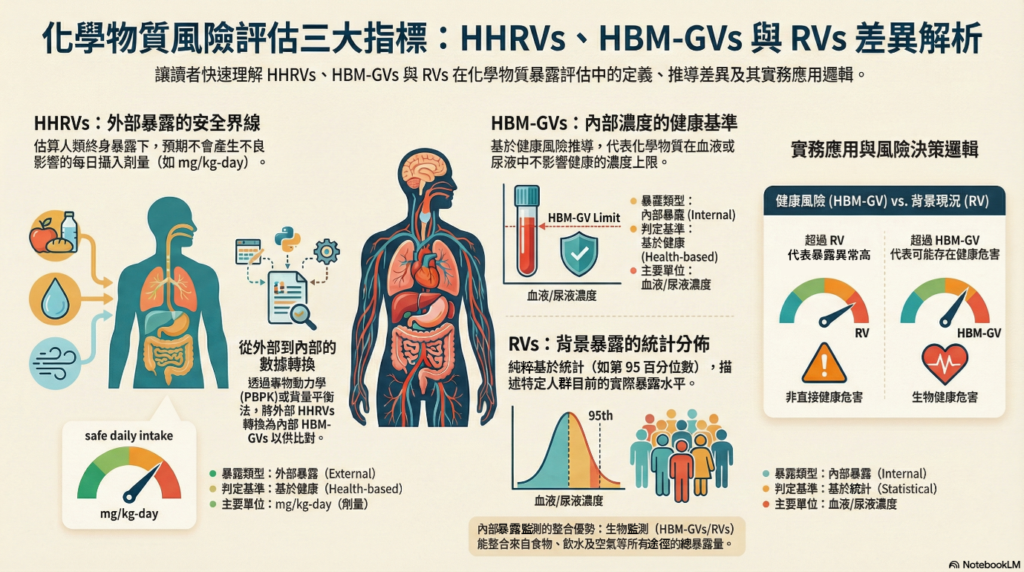
1. 核心概念解析
Human Health Reference Values (HHRVs – 人體健康參考值)
- 定義: HHRVs 是針對特定化學物質所估算的「安全或可接受的外部暴露水平」(例如參考劑量 RfD、可接受每日攝取量 ADI 、每日耐受量TDI或最低風險水平 MRL)。它代表人類在終身暴露下,預期不會產生不良健康影響的每日暴露劑量 (Holman, Francis, & Gray, 2017)。
- 推導方式: 主要透過毒理學測試找出「關鍵效應」的起始點劑量(Point of Departure, POD,如無觀察到不良反應劑量 NOAEL、最低觀察到不良反應劑量 LOAEL 或基準劑量下限 BMDL),將其除以總不確定性因子(Uncertainty Factors,用於涵蓋物種間差異、人類個體間差異等)來計算 (Holman, Francis, & Gray, 2017)。
- 單位: 通常以外部劑量表示(例如:mg/kg-day)。
Human biomonitoring guidance values (HBM-GVs – 人體生物監測指導值)
- 定義: HBM-GVs 是一種基於健康的指導值,代表化學物質或其代謝物在人體生物基質(如血液、尿液)中的「內部濃度基準」,在該濃度及以下,根據目前的知識預期不會產生健康風險 (Apel et al., 2023; Lamkarkach et al., 2021)。
- 推導方式: 主要有三種途徑:(1) 基於人體內部生物標記濃度與不良健康影響之間的直接流行病學關係(最穩健的方法);(2) 將外部的健康參考值(HHRVs )透過毒物動力學數據或模式轉換為對應的內部濃度;(3) 基於動物實驗的起始點劑量(POD)進行推導,換算為人體內部濃度,並加入不確定性因子以考量種間與個體差異 (Apel et al., 2023)。
- 分類: 可依適用族群區細分為一般人群的指導值(HBM-GVGenPop)和勞工的指導值(HBM-GVWorker)。不同國家或機構亦發展出多種HBM健康指導值或指標,例如德國的HBM-I/HBM-II或加拿大生物監測當量(Biomonitoring Equivalents, BEs)(Apel et al., 2023)。
Reference values (RVs – 人體生物監測參考值)
- 定義: RVs 是純粹基於統計學推導的數值,用以描述特定時間點下,定義的人群(或子群體)體內的污染物暴露分佈情況 (Hoopmann et al., 2023; Vogel et al., 2019)。
- 推導方式: 它是從實證研究樣本中得出的統計參數,目前國際上最常見的做法是將 RV 定義為該物質在樣本濃度分佈中的第 95 百分位數(RV95),有時會包含其 95% 信賴區間 (Hoopmann et al., 2023; Vogel et al., 2019)。
- 特點: RVs 不提供識別健康風險的標準。即使暴露量超過 RV,也不一定代表會對健康造成危害,它僅提供關於人群暴露現況的資訊 (Hoopmann et al., 2023; Vogel et al., 2019)。
2. 綜合分析與比較
這三個數值在化學品風險評估中扮演互補的角色,其主要差異可以從以下幾個維度進行比較:
A. 基於健康 (Health-based) vs. 基於統計 (Statistical)
- HHRVs 與 HBM-GVs 都是基於健康的指標。它們是根據毒理學或人類流行病學的危害數據推導而來,目的是定義一個「安全界線」,超過此界線可能會有健康疑慮 (Apel et al., 2023; Holman, Francis, & Gray, 2017)。
- 相反地,RVs 僅是基於統計的指標。它反映的是某個群體目前的「背景暴露現況」,其目的是幫助科學家或監管機構找出哪些人的暴露量處於人群的極端高端(例如前 5%),從而可能需要進一步關注或調查暴露來源,而非用來判斷是否生病 (Vogel et al., 2019)。
B. 外部暴露 (External Exposure) vs. 內部暴露 (Internal Exposure)
- HHRVs 衡量的是外部暴露,即評估人們從食物、飲水或空氣等介質中「攝入或接觸」的化學物質劑量(例如每日每公斤體重的人攝入多少毫克)(Holman, Francis, & Gray, 2017)。
- HBM-GVs 與 RVs 都是針對內部暴露(人體生物監測),衡量化學物質進入人體吸收、代謝、分布後,在尿液、血液或毛髮等生物檢體中的實際濃度 (Apel et al., 2023; Vogel et al., 2019)。內部暴露的優勢在於它整合了來自所有來源及所有途徑的總暴露量 (University of Cincinnati, 2021)。
C. 三者的實務轉換與應用
- 從 HHRVs 到 HBM-GVs: 因為 HHRVs 是外部劑量,在評估生物監測數據時難以直接比較,因此需要將 HHRVs轉換為對應的內部濃度(即 HBM-GVs)。常見作法包括使用生理基礎藥物動力學 (Physiologically based pharmacokinetic, PBPK) 模式進行正向劑量(forward dosimetry)推估,或採用較簡單的質量平衡法(mass balance approach),利用化學物質的尿液排泄分率與尿液流量等參數。兩種方法皆可將外部的 HHRVs 轉換為內部的HBM-GVs,以便直接與人體的檢測結果進行健康風險比對與判讀 (Apel et al., 2023; Nakayama et al., 2023; University of Cincinnati, 2021)。
- 風險管理上的互補: 當一個人的生物監測數據超過了 RVs 時,代表他比一般人接觸了更多該化學物質,是一個「異常高暴露」的警訊 (Vogel et al., 2019)。但如果要判斷這個異常高的暴露是否真的會危害他的健康,就必須將該數據與 HBM-GVs 進行比較;若超過 HBM-GV,則代表可能存在健康風險,需要採取風險管理行動來降低暴露 (Santonen et al., 2023)。
參考文獻
Apel, P., Lamkarkach, F., Lange, R., Sissoko, F., David, M., Rousselle, C., Schoeters, G., & Kolossa-Gehring, M. (2023). Human biomonitoring guidance values (HBM-GVs) for priority substances under the HBM4EU initiative – New values derivation for deltamethrin and cyfluthrin and overall results. International Journal of Hygiene and Environmental Health, 248, 114097. https://doi.org/10.1016/j.ijheh.2022.114097
Holman, E., Francis, R., & Gray, G. (2017). Part I––Comparing Noncancer Chronic Human Health Reference Values: An Analysis of Science Policy Choices. Risk Analysis, 37(5), 862-879. https://doi.org/10.1111/risa.12700
Hoopmann, M., Murawski, A., Schümann, M., Göen, T., Apel, P., Vogel, N., Kolossa-Gehring, M., & Röhl, C. (2023). A revised concept for deriving reference values for internal exposures to chemical substances and its application to population-representative biomonitoring data in German children and adolescents 2014–2017 (GerES V). International Journal of Hygiene and Environmental Health, 253, 114236. https://doi.org/10.1016/j.ijheh.2023.114236
Lamkarkach, F., Ougier, E., Garnier, R., Viau, C., Kolossa-Gehring, M., Lange, R., & Apel, P. (2021). Human biomonitoring initiative (HBM4EU): Human biomonitoring guidance values (HBM-GVs) derived for cadmium and its compounds. Environment International, 147, 106337. https://doi.org/10.1016/j.envint.2020.106337
Nakayama, S. F., St-Amand, A., Pollock, T., Apel, P., Bamai, Y. A., Barr, D. B., Bessems, J., Calafat, A. M., Castaño, A., Covaci, A., Duca, R. C., Faure, S., Galea, K. S., Hays, S., Hopf, N. B., Ito, Y., Jeddi, M. Z., Kolossa-Gehring, M., Kumar, E., LaKind, J. S., … Werry, K. (2023). Interpreting biomonitoring data: Introducing the international human biomonitoring (i-HBM) working group’s health-based guidance value (HB2GV) dashboard. International Journal of Hygiene and Environmental Health, 247, 114046. https://doi.org/10.1016/j.ijheh.2022.114046
Santonen, T., Mahiout, S., Alvito, P., Apel, P., Bessems, J., Bil, W., Borges, T., Bose-O’Reilly, S., Buekers, J., Cañas Portilla, A. I., Castaño Calvo, A., de Alba González, M., Domínguez-Morueco, N., Esteban López, M., Falnoga, I., Gerofke, A., González Caballero, M. d. C., Horvat, M., Huuskonen, P., … Schoeters, G. (2023). How to use human biomonitoring in chemical risk assessment: Methodological aspects, recommendations, and lessons learned from HBM4EU. International Journal of Hygiene and Environmental Health, 249, 114139. https://doi.org/10.1016/j.ijheh.2023.114139
University of Cincinnati. (2021). Guidance Document for Use of Human Biomonitoring Data for Exposure Assessment. Prepared for U.S. Consumer Product Safety Commission. https://www.cpsc.gov/content/Guidance-Document-for-use-of-Human-Biomonitoring-Data-for-Exposure-Assessment
Vogel, N., Conrad, A., Apel, P., Rucic, E., & Kolossa-Gehring, M. (2019). Human biomonitoring reference values: Differences and similarities between approaches for identifying unusually high exposure of pollutants in humans. International Journal of Hygiene and Environmental Health, 222(1), 30-33. https://doi.org/10.1016/j.ijheh.2018.08.002
編譯:廖合堂 博士
校稿:林怡君 副教授