

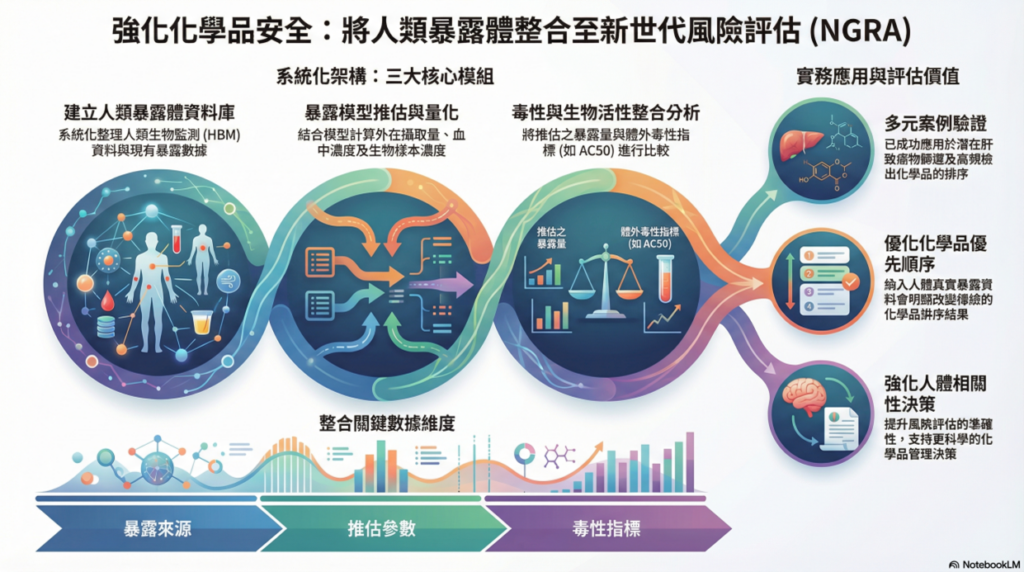
近日發表於《Environment International》的研究,旨在促進暴露體( exposome )研究與次世代風險評估( next-generation risk assessment, NGRA)的實務整合,以提升化學品安全評估之人體相關性。研究團隊建立一套彈性整合架構,結合人體生物監測(human biomonitoring, HBM)資料、暴露體資料庫、暴露模式推估結果,以及化學性質、毒性與生物活性資訊,用於支持NGRA與化學品優先排序決策。該架構包含三大模組:第一為系統化整理之人類暴露體資料庫;第二為模型推估之外在與體內暴露量;第三為毒性與生物活性資料整合分析。研究透過兩個案例驗證此架構:一為優先篩選潛在肝致癌物,二為依生物監測高頻檢出物進行暴露導向排序。該方法可推估生物樣本濃度、血中濃度與外在攝取量,並與體外毒性指標(如: AC50)比較。結果顯示,納入人體暴露資料會明顯改變化學品優先順序,有助於將暴露體資訊實際整合至 NGRA,強化人體相關之健康風險評估與決策。
參考文獻:Yifeng Dai, Bob van de Water, Jaione Telleria, Laura I. Furlong, Roel C.H. Vermeulen, Jelle Vlaanderen, Integrating human exposome data into next-generation risk assessment: a systematic framework to infer real-life exposure levels and prioritize chemical compounds for testing, Environment International, Volume 208, 2026, 110110, ISSN 0160-4120, https://doi.org/10.1016/j.envint.2026.110110.
編譯:何瑀琪 博士
校稿:林嬪嬪 研究員